For years, we have tended to explain scientific misconduct as a moral problem. The story seemed straightforward: there are honest researchers, and there are dishonest ones.
I suspect reality is considerably more uncomfortable. Perhaps the problem does not lie only with individuals. Perhaps it also lies in the rules of the game.
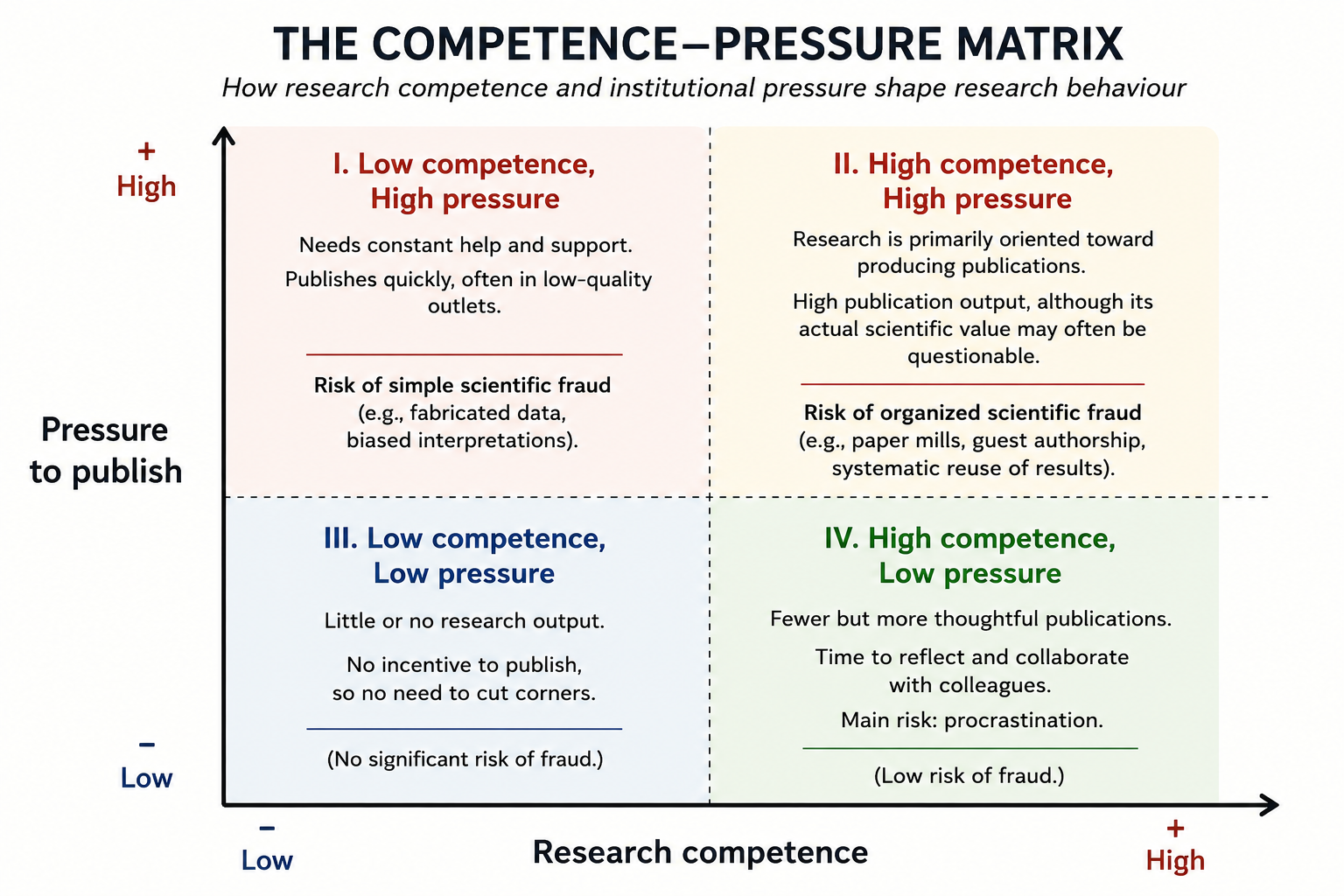
For some time, I have been thinking about a simple conceptual model that, while far from explaining everything, helps illuminate why certain research policies encourage very different behaviours. I call it the Competence–Pressure Matrix.
Two dimensions that change the picture
The model is built on two variables.
Research competence. By this I do not mean disciplinary expertise. Someone may be an outstanding lawyer, historian or economist and yet have little experience designing rigorous research. Research competence refers to mastering the craft of conducting research.
Institutional pressure to publish. In other words, the extent to which an academic career depends on producing a continuous stream of publications. The kind of pressure that turns publish or perish from a familiar expression into an institutional operating system.
Combining these two dimensions produces four markedly different scenarios.
I. Low competence, low pressure
With limited research competence and little institutional pressure, relatively little research is produced. Scientific progress may be slow, but there is also little incentive to fabricate results before learning how to produce them properly.
It is hardly an ideal environment for innovation, yet it is equally unlikely to generate spectacular cases of scientific misconduct.
II. Pressure before competence
This is where problems begin. Researchers face strong publication pressure before they have fully developed the skills needed to conduct independent research. Suddenly, there is always someone who runs the statistics, someone who improves the manuscript, someone who takes care of the methodology. Eventually, one begins to wonder who actually wrote the paper.
Research becomes modular, as if scientific knowledge could be assembled from a flat-pack kit. And, much like assembling certain Scandinavian furniture, there always seems to be one missing piece—even if nobody knows which one. In such an environment, misconduct stops being an exception and becomes a predictable temptation.
III. The luxury of having time to think
High research competence combined with low institutional pressure paints a very different picture. Publications may be less frequent, but they are often more thoughtful.
Researchers have time to collaborate, mentor colleagues and, above all, think. Here, the main enemy is rarely misconduct. It is procrastination—that familiar office companion who always promises to start on Monday.
IV. When research becomes a publication factory
The most worrying scenario emerges when high research competence meets intense institutional pressure.
Those who know the system best also know how to exploit it.
Research gradually shifts from producing knowledge to producing publications. Not necessarily better ones. Simply more of them.
This is the environment in which the most sophisticated forms of scientific misconduct emerge: honorary authorship, systematic recycling of results, publication pipelines and even the industrial production of manuscripts through paper mills.
High research competence combined with intense publication pressure creates ideal conditions for papers to become the objective of research rather than its outcome.
What are we really evaluating?
This model is not intended to classify researchers. Its purpose is to highlight something far more important: Research evaluation systems do not merely select researchers. They also shape researchers’ behaviour. If the dominant incentive is to publish more, then publishing more is precisely what the system will produce. Not necessarily more knowledge.
The irony is difficult to ignore. We design evaluation systems to reward scientific excellence, yet we often end up rewarding the ability to survive the system itself.
As if the goal were to manufacture papers with the efficiency of a yoghurt factory: perfectly packaged, remarkably similar and carrying an expiration date that arrives surprisingly soon.
Gradually, researchers stop asking:
“What problem is worth investigating?”
and begin asking:
“How many papers can I get out of this dataset?”
Those are not the same question.
And they certainly do not produce the same science.
Final thoughts
I am not suggesting that every researcher or every institution fits this model. Rather, I suspect that many of the dysfunctions we observe in contemporary academia are not simply the consequence of individual ethics.
They are also the product of the incentive structures we have built. When the paper ceases to be the natural consequence of research and becomes the purpose of research itself, something fundamental has changed.
Knowledge does not grow because we publish more papers. It grows because we ask better questions.